How roman shades work
Fabric that gathers into horizontal folds as it lifts, rather than rolling or stacking.
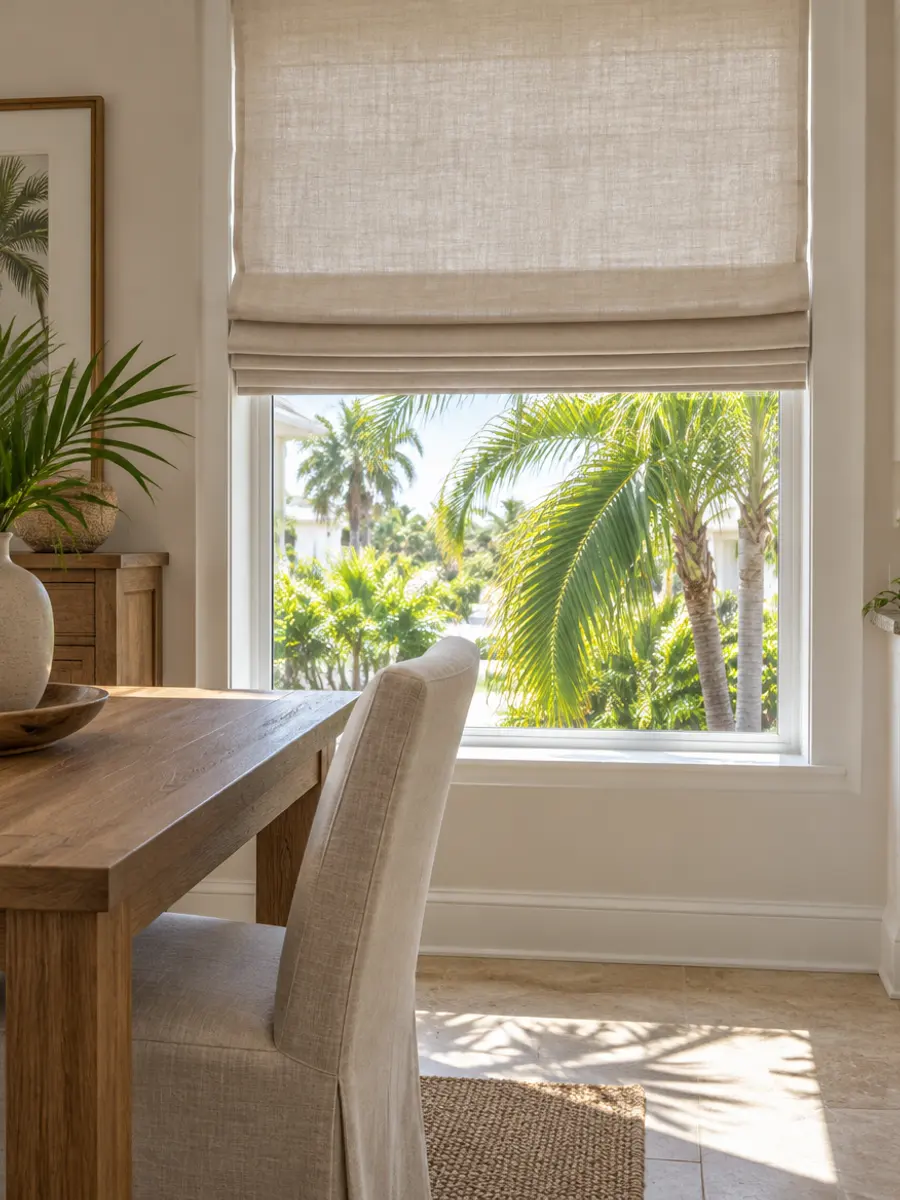
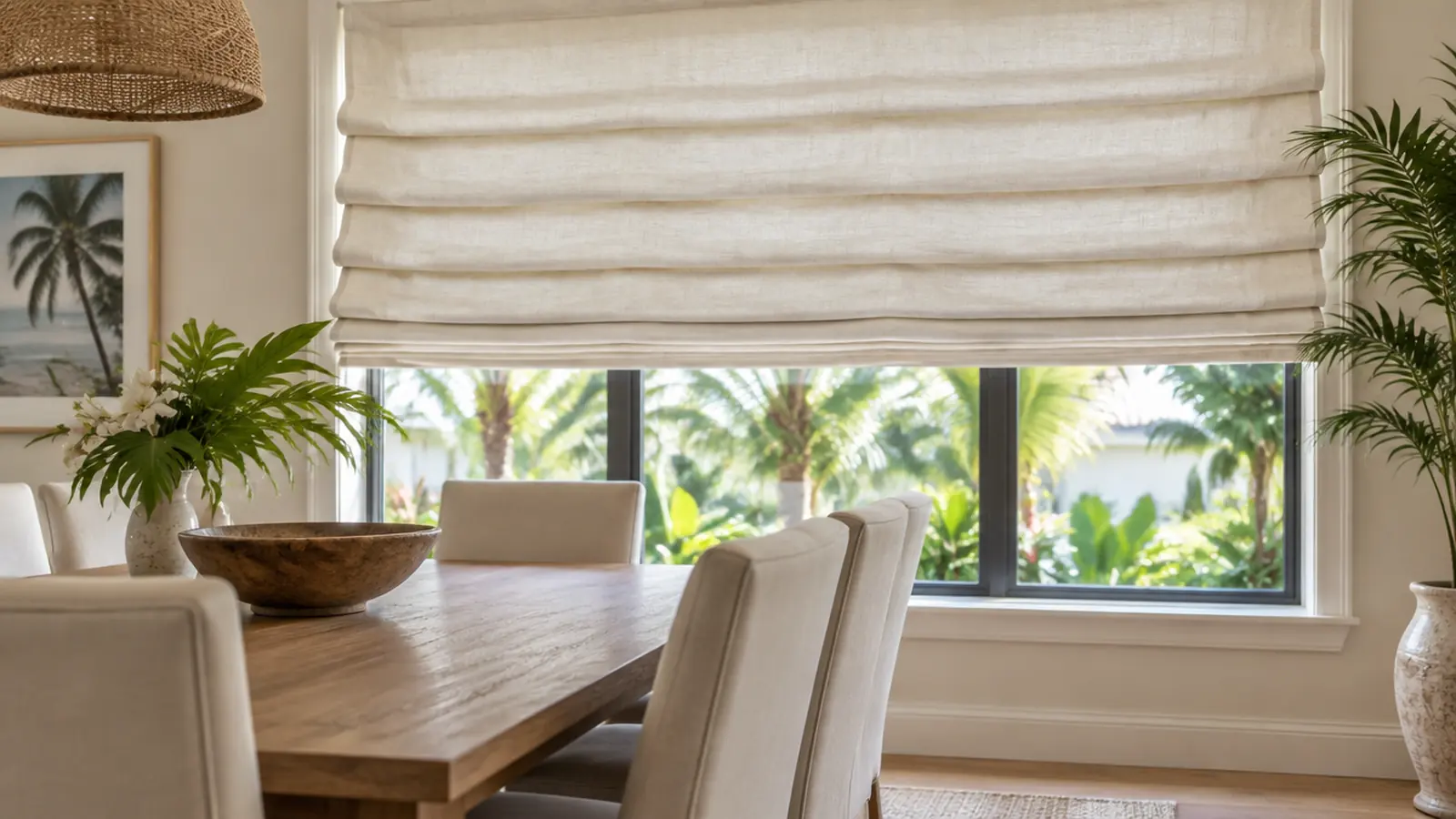
A roman shade is a flat panel of fabric with cords running up the back. Lifting it draws those cords and the fabric gathers into folds that sit one on top of another at the top of the window. Lowering it lets the folds fall out again until the panel is flat against the glass.
The result is a treatment made of real fabric that works like a shade. There is no tube and no stack of slats, so when it is down the window looks like a single piece of cloth, and when it is up the folds look deliberate rather than bunched. That is why a roman shade looks like furniture where a roller shade looks like hardware.
Where roman shades do best in a South Florida home
Rooms where everything else is already soft.
A dining room is the clearest case. The chairs are upholstered, there is usually a rug, and a hard flat shade at the window is the one thing in the room that looks like equipment. A roman shade puts fabric there without the width a pair of drapes needs.
Bedrooms are the other common one, particularly where there is no room either side of the window for drapery panels to stack. A roman shade gives the same softness inside the opening. The rooms to think twice about are the damp ones and the hard working ones: a kitchen window over a sink will mark the fabric, and a bathroom will hold moisture in it.
What you choose
The fold style, the fabric, and the lining behind it.
Flat fold goes up in clean horizontal bands and lies almost flat when it is down, which suits a plain room and a patterned fabric, because the pattern is not broken up. Hobbled fold keeps a gentle curve in the fabric at every height, so even fully lowered the shade has depth to it. Hobbled uses more fabric and looks more traditional.
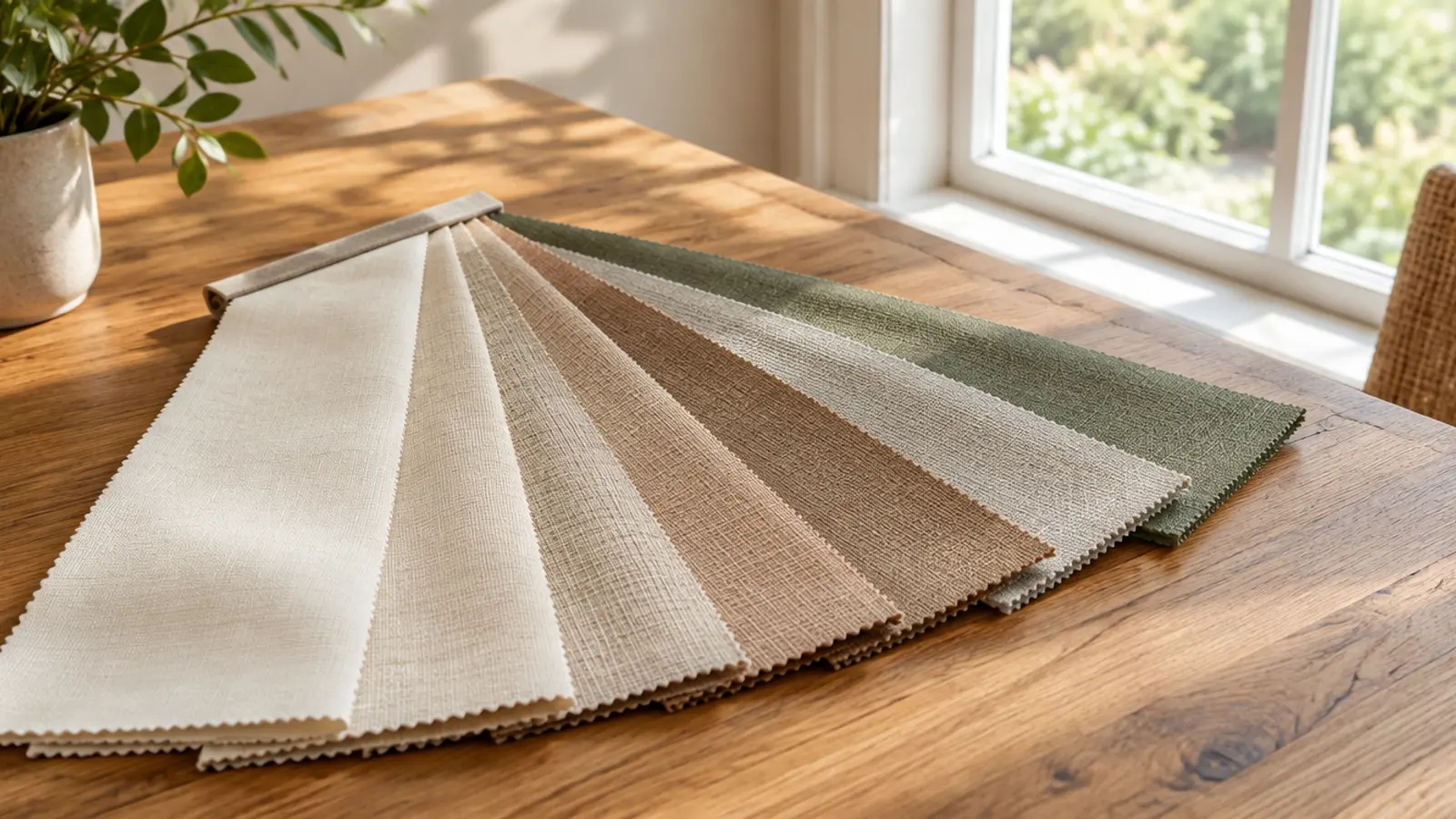
Fabric is the part people spend the longest on, and it is worth the time because it is the whole shade.
The lining is the quiet decision: unlined lets light through the weave and shows the fabric at its most alive, a light filtering lining evens everything out, and a blackout lining makes the shade do the job of a blackout blind while still looking like cloth.
Motorized roman shades
A motor lifts the folds evenly, which is the part that is fiddly by hand on a wide shade, and it removes the cords from a room where children might reach them. See how motorization works.
Pairings
What people pair them with
Very few windows end up with one thing on them, and the combinations below are the ones that come up most.
The nearest alternative is a cellular shade, which folds in a related way and does far more about heat, but looks like a functional product rather than like fabric. If the room needs the softness and the heat control, a cellular shade inside the opening with drapery panels either side gives you both for roughly the same money.
Roman shades sit happily under drapery panels on the same window, and that pairing is common in a dining room: the shade does the light and the panels frame the opening. Sheer curtains in front of a roman shade work less well, since both are fabric and the window starts to look crowded.
Allow for the stack when you measure the opening. A roman shade raised fully still has its folds gathered at the top, and on a tall shade with a heavy lining that stack can be eight inches deep. If the top of the window matters to you, an outside mount puts the stack above the glass instead of in it.
Pattern placement matters more here than on any other shade. Because the fabric folds, a large repeat can land awkwardly, with half a motif at the hem. We work out where the folds fall before the fabric is cut, which is something an off-the-shelf shade never does.
The rest of the shades we make are roller shades , zebra shades , cellular shades and solar shades , and we will bring samples of whichever ones suit the room.
Before you book
Questions about roman shades
Anything not answered here gets answered at the appointment, and it costs nothing to ask.
Flat fold or hobbled?
Flat if the fabric has a pattern worth seeing whole, or if the room is modern. Hobbled if the room is traditional and you want the window to look dressed even when the shade is all the way down. There is no functional difference.
Can a roman shade block out light?
With a blackout lining, yes, as well as any blackout roller. Mounted inside the opening it still leaves a line of light down each side, so for a bedroom that must be properly dark an outside mount is the better choice.
Will the fabric fade?
Any fabric in direct sun changes over years. A lining takes most of that, which is one of the practical arguments for lining a shade even when you like the unlined look. On a west-facing window, lining is the sensible choice.
How wide can one go?
Wider than most people expect, but weight becomes the limit rather than the mechanism, especially with a heavy fabric and a blackout lining. On a very wide opening we will usually suggest two shades, because one enormous one is unpleasant to lift and the folds stop hanging evenly.
Can I supply my own fabric?
Often, and it depends on the fabric. Some upholstery weights are too stiff to fold cleanly and some sheers are too light to hang straight. Bring it to the appointment and we will tell you honestly whether it will work as a roman shade before anybody cuts anything.
I'd like to explore my options
Let's make your home feel complete. We will reach out and help you get started.